Precision File Size, Bandwidth & Storage Calculators
Fast, accurate, and completely free online calculators for digital storage, file transfer times, internet speed conversions, and data usage planning.
Popular Calculators & Converters
Our most frequently used utilities by developers, IT admins, and digital creators.
MB to GB Converter
Convert Megabytes (MB) to Gigabytes (GB) in both Decimal (SI) and Binary (IEC) standards.
File Size Converter
Universal multi-unit file size converter across Bit, Byte, KB, MB, GB, TB, PB, KiB, MiB, GiB, TiB.
Download Time Calculator
Estimate how long it will take to download any file based on file size and internet connection speed.
Bandwidth Calculator
Calculate required data transfer bandwidth based on visitors, average page weight, and frequency.
File Size Converters
Bidirectional converters for Bits, Bytes, KB, MB, GB, and TB units.
MB to GB Converter
Convert Megabytes (MB) to Gigabytes (GB) in both Decimal (SI) and Binary (IEC) standards.
GB to MB Converter
Convert Gigabytes (GB) to Megabytes (MB) with instant binary and decimal calculations.
KB to MB Converter
Convert Kilobytes (KB) to Megabytes (MB) for documents, images, and web assets.
MB to KB Converter
Convert Megabytes (MB) into Kilobytes (KB) for precise file buffer sizing.
GB to TB Converter
Convert Gigabytes (GB) to Terabytes (TB) for server storage, NAS, and SSD capacity.
TB to GB Converter
Convert Terabytes (TB) to Gigabytes (GB) with complete decimal and binary options.
Bytes to KB Converter
Convert raw Bytes into Kilobytes (KB) for software engineering and payload optimization.
KB to Bytes Converter
Convert Kilobytes (KB) to exact Bytes with zero rounding error.
Bits to Bytes Converter
Convert digital Bits (b) to Bytes (B) using the standard 8-to-1 ratio.
Bytes to Bits Converter
Convert Bytes (B) to Bits (b) for networking, throughput, and baud calculations.
File Size Converter
Universal multi-unit file size converter across Bit, Byte, KB, MB, GB, TB, PB, KiB, MiB, GiB, TiB.
Email Attachment Size Checker
Check email attachment limits for Gmail, Outlook, Yahoo, and iCloud with Base64 encoding overhead calculation.
Compression Ratio Calculator
Calculate compression ratio, space saved percentage, and reduction factor for ZIP, RAR, 7z, and tar.gz files.
Binary vs Decimal Unit Converter
Understand why your 1 TB drive shows as 931 GiB in Windows. Compare SI decimal (1000) vs IEC binary (1024) units.
Internet Speed Tools
Speed calculators to convert between Mbps, MB/s, Gbps, and transfer metrics.
Download Time Calculator
Estimate how long it will take to download any file based on file size and internet connection speed.
Upload Time Calculator
Calculate estimated upload times for YouTube videos, cloud backups, and large files.
File Transfer Time Calculator
Calculate local network (LAN) and hardware bus transfer times across USB 2.0, USB 3.0, Thunderbolt, and Ethernet.
Internet Speed Converter
Convert internet speed units between bps, Kbps, Mbps, Gbps, B/s, KB/s, MB/s, and GB/s.
Bandwidth Calculators
Estimate website, network, and hosting data transfer consumption.
Storage Calculators
Calculate cloud, hosting, backup, and RAID storage capacities accurately.
Video File Size Calculator
Calculate video file size based on resolution, duration, bitrate, and modern codecs (H.264, H.265, AV1, ProRes).
Audio File Size Calculator
Estimate audio file sizes for MP3, WAV, FLAC, and AAC based on duration, sample rate, and bit depth.
Image File Size Estimator
Estimate image file size from pixel dimensions, color depth, megapixels, and format (JPEG, PNG, WebP, AVIF, RAW).
Cloud Storage Calculator
Compare monthly cloud storage and egress bandwidth costs across AWS S3, Google Cloud, Azure, Wasabi, and Backblaze B2.
Hosting Storage Calculator
Calculate website disk space requirements for CMS files, database, email accounts, and media uploads.
Backup Storage Calculator
Calculate total storage required for full and incremental backup retention schemes.
RAID Storage Calculator
Calculate usable capacity, fault tolerance, parity overhead, and speed gain for RAID 0, 1, 5, 6, and 10.
Data Usage Tools
Track and forecast mobile data, video streaming, and download limits.
Monthly Data Usage Calculator
Estimate total home broadband data usage from streaming, gaming, browsing, and work from home.
Mobile Data Usage Calculator
Calculate mobile cellular data requirements based on daily social media, navigation, video, and music usage.
Streaming Data Usage Calculator
Calculate data usage for Netflix, YouTube, Twitch, Disney+, and Prime Video across SD, HD, and 4K UHD resolutions.
How Digital File Sizes & Bandwidth Are Measured
Digital files are stored as binary data, consisting of microscopic magnetic, electrical, or optical pulses represented as 1s and 0s called bits. While physical serial networks transfer data one bit at a time, filesystems and operating systems group eight bits together into a single Byte.
Decimal Standard (SI Base 10)
Widely adopted by storage hardware manufacturers (SSD, HDD, USB drives) and networking equipment. 1 Kilobyte = 1,000 Bytes; 1 Megabyte = 1,000,000 Bytes; 1 Gigabyte = 1,000,000,000 Bytes.
Binary Standard (IEC Base 2)
Used natively by computer processors, RAM architectures, and operating systems like Microsoft Windows. 1 Kibibyte (KiB) = 1,024 Bytes; 1 Mebibyte (MiB) = 1,048,576 Bytes; 1 Gibibyte (GiB) = 1,073,741,824 Bytes.
Network Bitrate vs File Size
Internet service providers quote connection speeds in Megabits per second (Mbps) with a lowercase 'b', while browsers display downloads in Megabytes per second (MB/s) with an uppercase 'B'. Always divide your Mbps speed by 8 to find your maximum file transfer rate.
Why Accurate Bandwidth & Storage Sizing Matters
Whether you are selecting a web hosting plan on Hostinger, sizing an Amazon S3 cloud storage bucket, planning a Synology NAS RAID array, or managing a home broadband data cap, guessing leads to either service downtime or hundreds of dollars in wasted subscription fees. Our interactive tools provide instant, mathematically rigorous models with real-world protocol overheads factored in.
Frequently Asked Questions
Common questions regarding file conversions, speed calculations, and storage units.
In standard decimal notation (SI), 1 Gigabyte (GB) = 1,000 Megabytes (MB). In binary computer memory notation (IEC), 1 Gibibyte (GiB) = 1,024 Mebibytes (MiB). Most mobile cellular networks and hard drive makers use the 1,000 MB definition, while Windows calculates memory in 1,024 MiB blocks.
Real-world network transmissions must account for TCP/IP packet header overheads (typically 5% to 10%), local Wi-Fi interference, routing latency, and server-side rate limiting. Our Download Time Calculator includes an adjustable realistic overhead factor to model real conditions.
Yes, 100%. All calculations on FileSizeHub execute locally on your device within your web browser using client-side JavaScript. We do not transmit, log, or store your numeric inputs or file details on any server.
Hard drive manufacturers define 1 TB as 1,000,000,000,000 bytes (decimal). Windows, however, divides this byte total by 1,024 three times (1,073,741,824) to calculate binary Gibibytes (GiB), arriving at 931.32 GiB. Windows then incorrectly displays the unit label as "GB" instead of "GiB".
Latest Guides & Storage Tutorials
Deep technical explanations, broadband comparisons, and storage hardware guides.
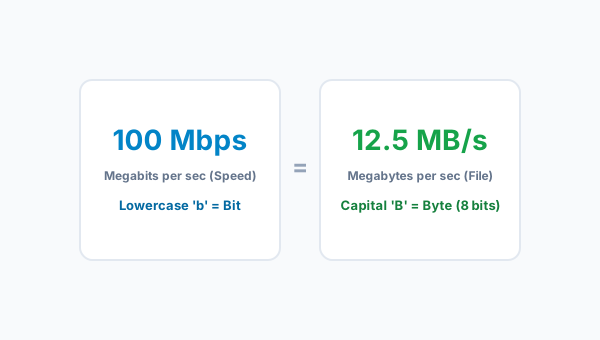
Mbps vs MBps: The Simple Guide to Bits, Bytes, and Broadband Speeds
Never get confused by broadband marketing again. We explain the difference between Mbps and MBps, how to read speed tests, and convert connection speeds.
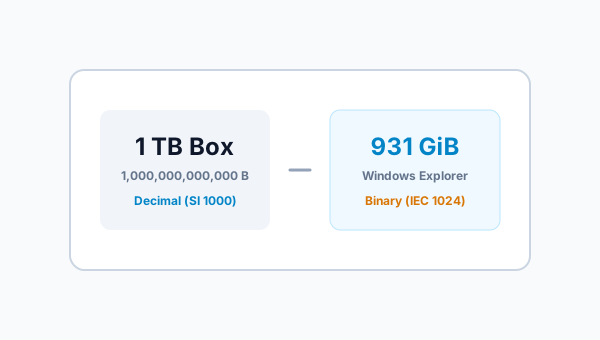
Binary vs Decimal File Size Units Explained: Why Your 1 TB Drive is Only 931 GB
The complete technical history of SI decimal prefixes vs IEC binary prefixes, and why your brand-new hard drive or SSD appears smaller in Windows.
How to Calculate Download Time Accurately: Overheads, Speeds & Latency
A step-by-step technical guide to calculating true download and upload completion times, including protocol overheads, bandwidth throttling, and Wi-Fi variables.