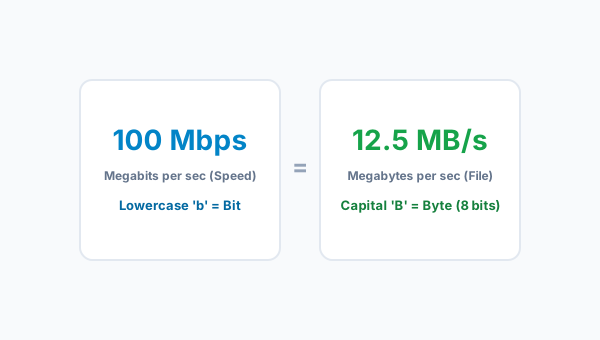
The One Letter That Changes Everything: Small "b" vs Capital "B"
Few technology marketing conventions cause as much frustration and misunderstanding as the difference between Mbps and MBps. To the untrained eye, they appear identical. Yet that tiny typographic detail—a lowercase b versus an uppercase B—represents an eight-fold difference in data volume.
The Basic Rule
Remember this simple distinction:
- Lowercase "b" = bit: The smallest binary unit of computing. Used for telecommunications speeds and data transfer rates (e.g., Mbps = Megabits per second).
- Uppercase "B" = Byte: A bundle of 8 bits. Used for storage capacity and file sizes (e.g., MB/s or MBps = Megabytes per second).
| Metric | Symbol | Primary Usage | Equivalence |
|---|---|---|---|
| Megabit per second | Mbps or Mb/s | ISP Broadband, Wi-Fi routers, Video streaming bitrates | 1 Mbps = 0.125 MB/s |
| Megabyte per second | MB/s or MBps | File downloads, SSD/HDD transfer speeds, RAM throughput | 1 MB/s = 8 Mbps |
Why Do ISPs Advertise in Megabits (Mbps)?
Consumers frequently wonder why internet service providers do not simply quote download speeds in Megabytes per second. While marketing teams certainly enjoy advertising "100 Mbps" instead of "12.5 MB/s" because the number looks eight times larger, there is also a sound engineering rationale.
Serial communication lines transmit data across fiber optic glass or copper wires one individual bit at a time. The physical clock frequency of the transmission hardware measures signal state changes per second (baud rate and bit rate). Network engineers have therefore measured throughput in bits per second since the dawn of ARPANET.
Quick Reference Cheat Sheet
Use this handy cheat sheet to translate your ISP package into real-world download speed:
- 25 Mbps plan: ~3.1 MB/s download speed
- 50 Mbps plan: ~6.25 MB/s download speed
- 100 Mbps plan: ~12.5 MB/s download speed
- 300 Mbps plan: ~37.5 MB/s download speed
- 500 Mbps plan: ~62.5 MB/s download speed
- 1,000 Mbps (1 Gbps Gigabit) plan: ~125 MB/s download speed
Want to convert custom numbers instantly? Try our free Internet Speed Converter.

Sarah Lin
Data & Storage Contributor
Sarah produces practical walkthroughs explaining storage capacity, backup planning, and bandwidth optimization metrics for FileSizeHub.